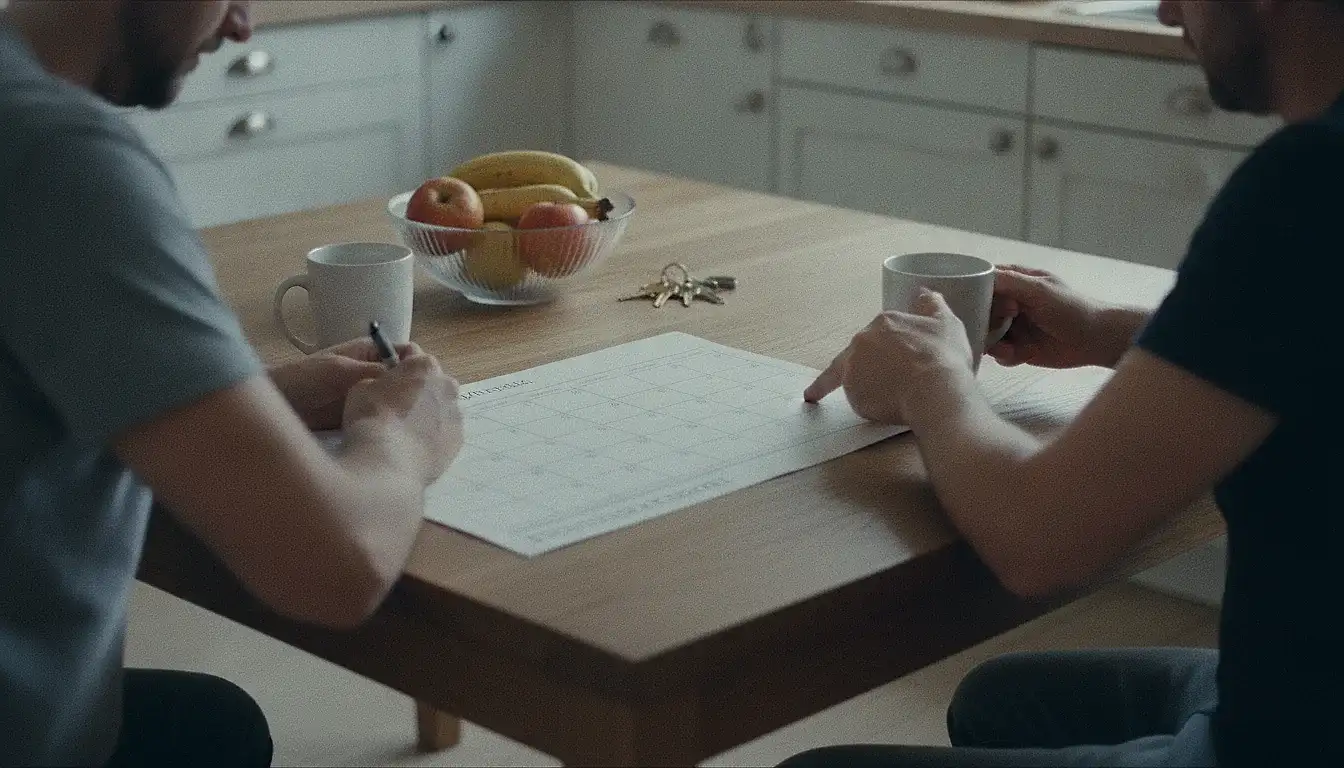
Marriage advice is any suggestion about how two married people should treat each other. It arrives from parents, from books with a system in them, and from strangers with a confident opinion, and it never says which week it was written for. The line that sounded wise on Sunday still has to be carried out on a Thursday with a sick child in the house, and that is where the sorting happens: some of it can still be done, and the rest turns into something you have failed.
This guide is secular and non-clinical. It does not prescribe therapy, and it does not tell you what your marriage means. It covers the ground couples end up negotiating — money, time, household work, and closeness — plus the question sets we use to start those conversations, gathered on the question decks page. Where a topic needs professional help rather than an article, we say so and stop.
What kind of marriage advice actually changes anything?
Advice changes something when it is behavioural, specific and repeatable: it names an action, not a feeling; it fits an ordinary evening rather than an ideal one; and it survives being done badly. Advice that fails every one of those tests is not wrong, exactly. It is just unusable, which in practice amounts to the same thing.
The difference is easiest to see side by side. “Be more present” is a state. “Put the phone in the other room while we eat” is a decision, and either of you can tell within a week whether it happened. “Prioritise your marriage” is a value. “Neither of us schedules anything on Thursday evenings until the other one knows about it” is an arrangement, with a visible failure mode: somebody scheduled something, and now you know what to talk about.
Those tests, applied to advice you already have lying around:
- For example, take “communicate better”. Behavioural? No — it names no action. Rewritten as something you could actually do, it becomes: when a conversation starts going badly, one of you says the disagreement out loud in a single sentence before either of you argues with it. That version can be practised, fumbled, and tried again, which is what talking to each other without it turning into a fight is made of.
- For instance, take “never keep score”. As stated, it asks for a mental state nobody controls. As an arrangement, it becomes: at some regular interval you both write down the household jobs you did without being asked, and compare lists — not to settle a debt, but because the invisible work is invisible in both directions, and scorekeeping starts as unshared information more readily than as bad faith.
- Consider “keep dating each other”. Lovely, and completely unspecific. The workable version fixes a time, a person doing the booking, and a fallback for the evening it collapses. That is why date night ideas are more useful than the instruction to have one.
One more thing separates advice that works from advice that merely sounds right: someone has to be able to start it alone. Anything that requires both people to be motivated on the same evening is not a practice, it is a coincidence.
There is another quality that separates advice worth keeping: it should be reversible. A good arrangement can be renegotiated out loud without either person losing face. Advice that hardens into a rule you can only fail — the weekly date, the daily check-in, the vow about anger and bedtime — starts as a plan and ends as evidence in an argument.
What do couples argue about, and where does each conversation live?
The arguments that keep coming back gather around money, time, household work and closeness, and the same subjects show up under any number of surface topics. The argument about the dishwasher is an argument about the household load. The argument about a phone at dinner is an argument about attention. Naming the real subject is much of the work, and each of those subjects has its own page here.
| The argument on the surface | What the argument is actually about | Where the conversation lives here |
|---|---|---|
| A purchase one of you would not have made | How money gets decided, and whose spending needs a conversation first | Money: budgeting, accounts, and the money talk |
| The dishwasher, the laundry, the school run | The household load and whether the split was ever actually agreed | Boundaries: agreements between equals |
| The phone at dinner, the late meeting, the weekend that filled up | Attention and protected time | Closeness: reconnecting, romance, date night |
| The same argument, restarting from the beginning every time | How the two of you talk when you disagree | Communication: starting hard conversations |
In links, that map reads: money goes to budgeting for couples; the household load and the unwritten rules about phones, in-laws and time go to boundaries in marriage; distance and attention go to reconnecting with your spouse and date night ideas; the mechanics of a hard conversation go to communicating better. If you want the framework version of all of this rather than the by-topic version, the seven principles page covers the best-known secular model of what makes marriages work.
Which of those should you take on first?
Take on the one that has produced the most recent arguments, not the one that feels most important in the abstract. It is tempting to open with the largest subject — closeness, which carries the most feeling — and then stall, because closeness is downstream of the others. Resentment about the household load does not respond to a nicer evening.
Money is a sensible first move for a practical reason: it is the most decidable of them. Two people can sit down and settle how accounts work, what size of purchase gets a conversation, and who watches the bills, and the answers stay settled for a long stretch. Household work is close behind for the same reason. Time and closeness are harder to legislate and easier to protect once those stop generating friction.
There is one exception worth naming. If the two of you are early enough that the arrangements have never been made rather than made and broken, start by making them: that is what the first year of marriage is largely for, and the same ground gets covered by the questions to ask before getting married.
One boundary worth stating early: this site does not run through the well-known catalogue of conflict behaviours named by relationship researchers — that material belongs to a different reference guide, and we do not reproduce it here.
Why does popular marriage advice not survive a real week?
Popular advice breaks because it assumes a week with slack in it: an evening free, both of you in the same mood, and nothing urgent. Real weeks contain illness, travel, deadlines and small children. Advice built for the calm version does not degrade gracefully — it simply stops, and the couple reads the stoppage as a verdict on the marriage rather than on the advice.
Take the lines this genre keeps repeating. “Never go to bed angry” was written for arguments that resolve quickly; applied to a real disagreement at midnight, it produces an exhausted conversation that neither person can think straight in, and the same fight again on less sleep. “Have a date night every week” assumes a spare evening and spare money, and it converts a nice idea into a weekly opportunity to fail.
The failure is structural, not moral. Advice written as a standard is either kept or broken, and a real week eventually breaks it. Advice written as a default can also be adapted and returned to. The difference sounds like semantics until you notice which version couples abandon first.
What replaces the standard is a smaller, sturdier version of the same intention:
- Imagine the midnight argument again, run as a default rather than a rule. Instead of finishing it, one of you says which part you will pick up and when: “I want to sort out the money thing, not tonight — before work tomorrow.” The disagreement is not resolved. It is parked somewhere you can both find it, which is the part that keeps it from leaking into the days that follow.
- For example, the weekly date night, downgraded to something achievable: a standing evening that belongs to the two of you, which sometimes looks like a restaurant and sometimes looks like a walk after the children are asleep. What matters is that it is scheduled and protected, not that it is impressive.
Do the named rules, like the 2-2-2 rule, actually help?
The named rules are scheduling conventions with a memorable label, and they help exactly as much as any schedule you would keep anyway. The 2-2-2 rule is the best known: a date at one interval, an overnight away at a longer one, a proper holiday at a longer one still. Nothing about the numbers in the name is a finding. They are a mnemonic, and treating them as a standard produces the usual result — a couple who have failed a rule they never chose.
What the convention gets right is the principle underneath it: time together is more reliable when it is booked at different scales, because the short version keeps getting eaten by the week and the long version keeps getting postponed by money. Borrow the shape, set the intervals your life can actually hold, and drop the label. We keep the whole family of named rules, and the questions people ask about them, on the FAQ page, and the practical version — what to actually do with the evening once it is booked — sits with date night ideas.
Another pattern in this genre deserves naming: advice that quietly requires your spouse to change. Anything phrased as what your partner ought to start doing is not advice, because you cannot perform it. The version you can act on describes what you will say, or what you will propose, and leaves the other person genuinely free to answer.
The check-in questions we actually use
That did not go through. Nothing was saved and nothing was sent. Try the address again, or write to us directly and we will add you by hand.
- What arrives
- One question worth asking your spouse this week, and the shortest honest account of when it works.
- What does not
- No rules with numbers in them, no promises about outcomes, and no third party ever gets the address.
What advice do long-married couples actually give?
Advice passed on by people who have been married a long time sounds different from the advice the industry sells: it is about maintenance rather than romance, and about ordinary politeness rather than passion. The recurring themes are unglamorous — keep talking about money, keep saying thank you for the boring work, keep some interests of your own, and assume the person you married will keep changing.
That last one carries more weight than it looks. Long-married people describe the person across the table as somebody they have met several times over: different later than they were at the start, different again after a job change or a bereavement. Surprises are fewer when the questions keep coming after they have stopped being necessary — which is the entire premise of how well do you know your spouse as an exercise.
The best-known secular attempt to systematise this kind of accumulated advice is The Seven Principles for Making Marriage Work, a book by researcher John Gottman and Nan Silver, which gathers what long-observed couples appeared to be doing rather than what they said they believed. We summarise its principles, and where they came from, on our seven principles page; the book itself is Gottman and Silver’s practical guide, and it belongs to its publisher, not to us.

The advice worth ignoring
A few lines this genre repeats are actively unhelpful, and they are worth naming rather than politely skipping.
- “Happy wife, happy life.” It is a joke that hardened into a household policy, and it installs one person as the manager of the other’s mood. The version aimed at husbands is the same shape in reverse. Advice sorted by gender describes a decade rather than a couple.
- “Don’t sweat the small stuff.” Household work is small stuff. Whose evening gets interrupted is small stuff. The small stuff is what marriages are largely made of, and the instruction to ignore it benefits whoever is currently not doing it.
- “Marriage is hard work.” True enough to sound wise and vague enough to justify anything, including arrangements nobody would accept if they were described plainly. Work at what, exactly, is the question the phrase talks you out of asking.
- “Just have more sex” or “just take a holiday.” Both can be genuinely good ideas and neither is an answer to a specific problem. A holiday with an unresolved money argument in the luggage is that argument in a nicer setting.
The funniest advice in the genre is the same category with better delivery: separate duvets, separate bathrooms, never renovate a kitchen together. Underneath the joke sits a real, modest, workable principle — reduce the friction you can actually reduce — which is more than the earnest version of the same page manages.
What do couples say they wish they had been told?
A familiar regret is not about romance at all. It is about assumptions: things each person believed had been agreed, which were never actually discussed — where holidays are spent, whose career moves the household, how much help from parents is normal, what counts as a big purchase. None of those are secrets. They are simply defaults each of you imported from a different family and never compared.
Another familiar regret is timing: that the money conversation, or the one about how much of the household each of you would carry, happened after resentment had already formed rather than before. A conversation that would have been administrative early on becomes an accusation years later, and the content has not changed at all — only the debt attached to it.
The workable form of both regrets is the same: put the assumption into a question and ask it out loud, before it has anything riding on it. That is the entire function of the question decks, and the reason they are sorted by the evening you are having rather than by theme.
Where should you start if things feel stuck?
Start with the narrowest true description of the problem you can write, then take that one thing to one conversation. “We are not doing well” cannot be acted on. “We have not decided who books anything, so nothing gets booked” can. Stuck is not a single condition; it is a set of arrangements that stopped fitting and were never revisited.
It also helps to lower what a first conversation is expected to achieve. A conversation that has to produce agreement, apology and a plan in one sitting will be avoided for a long time. A conversation that only has to establish what each of you thinks the current arrangement is can happen on a weeknight, and it removes more confusion than it sounds like it should.
Where to start, depending on where you actually are:
If the two of you still talk easily but the week has gone flat, start with the question decks — questions to ask your spouse for ordinary evenings, or the date night questions if there is an evening already booked. The point is not the questions; it is having something to ask that neither of you can answer on autopilot.
If a specific subject keeps producing the same argument, go straight to that subject: money, boundaries for time and household rules, or communication if the pattern is that every subject ends the same way.
If the distance is the problem rather than any one topic, reconnecting with your spouse is the place to start, and feeling lonely in a marriage covers the version where you are lonely in the same room. If this has been true for a long stretch, or if anything about your situation touches safety, that is past what a page can do and belongs with a trained professional; how we decide what to publish and what to route elsewhere is set out on our sources page.
And if only one of you is reading this, that is the ordinary case rather than a bad sign. One person can change the conditions — propose an arrangement, protect an evening, ask a better question — and one person cannot deliver an outcome. The honest version of a one-sided start is to make the proposal specific and small enough that agreeing to it costs your spouse very little, and then to watch what happens over weeks rather than over a single conversation. Presenting an article as evidence, by contrast, tends to land as a case being made against somebody.
What this guide does not do
The category sells certainty, because certainty converts. Here is what we will not claim.
- No numbers
- This site publishes no statistics. The best-known figures in marriage advice — divorce percentages, ratios of positive to negative moments, prediction accuracy — get repeated far past their original context, so we quote none of them and write around them instead.
- No diagnosis of your marriage
- We do not tell you whether your marriage is failing, healthy, or over. Nobody can read that from a page of behaviours, and the guess would arrive with more authority than it earned.
- No promises
- No page here claims it will save, repair or protect a marriage. Advice can change what you try this week; the outcome is not ours to sell.
- No therapy in disguise
- We describe conversational practices, not clinical protocols. A long stretch of the same distance, or anything touching safety, is where the article stops and a trained professional starts — we say so and leave it there rather than improvise a protocol.
- No advice sorted by gender
- Advice for wives and advice for husbands is the same advice with a stereotype attached. We write for whichever of you is reading.
What we do stand behind
- Behaviour, not verdicts
- Every page describes what somebody said or did, in a scene you can recognise, rather than labelling a person.
- Secular and specific
- No faith framing, no vows-and-destiny language: arrangements two adults can negotiate, in the vocabulary they already use.
- Sourced when we reference research
- When a page refers to published work, it names the work and links to it, and it never converts that work into a number we cannot verify. Our checking process is on the sources page.
- Dated
- Every page carries the month it was last checked, so you can see how old the thinking is.
The rest of this site is organised the way the arguments are: the question decks for when you need something to ask, the foundations pages for money, boundaries and communication, the closeness pages for getting back into each other’s week, and the drifting pages for the harder stretches. Cross-topic questions — including the various named rules people ask about, like the 2-2-2 rule — are collected on the FAQ page.
Checked: 2026-09.